One more step towards progress

In a constantly evolving sector, it is up to the aviation community to anticipate the needs for environmental protection by maximizing eco-responsible projects. Over the past 20 years, aircraft construction has seen significant technological advancements that greatly reduce environmental impacts.
Aéropyrénées is committed to an environmental approach, following the Pro Tarmac certification, with the purchase of two SONACA 200 models developed by the Sonaca Group. We are taking action to renew our fleet while supporting industrial research for more fuel-efficient aircraft and engines
It is also in the interest of airlines to benefit from modern aircraft that are more environmentally friendly. Today’s airplanes consume less fuel and are easier to maintain, more comfortable for passengers, and more crew-friendly for crews. The same applies to aviation schools. The goal is to reduce aviation emissions, and this is what aircraft manufacturers are working on. These innovative projects are supported by Aéropyrénées, and they are very important to us!
Presentation of the SONACA 200
Drawing on the experience of the Group, Sonaca Aircraft has developed and launched the SONACA 200, a certified aircraft designed for optimized flight performance and reduced operational costs. In collaboration with industry players (flying clubs, pilot schools, private pilots, etc.), the SONACA 200 meets the needs of the general aviation and training sectors. This model combines design and functionality for the pilot, showcasing its agility and balance through its graceful, modern lines. Special attention has been given to the elongated engine cowling, designed to maximize propeller efficiency. It features a semi-rigid aluminum structure, with the fuselage, wings, and tail also made from aluminum alloy. The use of aluminum significantly reduces its weight, making it about one-third lighter than steel, which allows the aircraft to be more fuel-efficient and offer a higher payload. Additionally, it is a highly durable material.

A foolproof performance

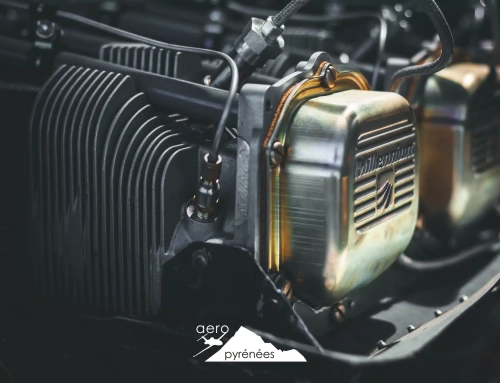
The SONACA 200 is equipped with the certified Rotax 914 turbocharged engine, which delivers high performance for climb rates and equally efficient cruise speeds. It also offers excellent performance at high altitudes with minimal weight.
The aircraft’s riveted structure is fully metalized to provide a strong frame while also facilitating repairs in case of damage, which is highly appreciated by schools and flying clubs.
An environmental breakthrough in the world of aviation
The overall aerodynamic profile of the Sonaca 200 and its suitable engine enable it to achieve high climb rates, short takeoffs, and a comfortable cruise speed for long journeys on board.
Its greatest innovation comes from its next-generation engine and the optimization of its aerodynamic lines, making it a very economical aircraft. Its wing tips also feature an elliptical shape that enhances its aerodynamic performance.

Other physical features, such as its large control surfaces and ground clearance at the tips of its wings, allow it to land in crosswinds of up to 20 knots. It offers a very comfortable payload margin due to its lightweight empty mass, which combines with a maximum takeoff weight of 750 kg. A true technical and environmental achievement in the history of aviation!
Noise reduction

Due to its design, Aéropyrénées, concerned about the environment and the users around the platform, has acquired two S200 aircraft, enabling young trainee pilots to reduce the impact in terms of noise pollution, especially during circuits, which is an essential part of professional training. To sustainably reconcile the interests of light aviation users with the expectations of local residents, we are making every effort within our capabilities.
A word from management

Today, we are one of the key players in pilot training, and it is important for us to address various challenges, whether they are social or environmental. Although I recognize that we currently do not have a reliable electric solution in our field, it is crucial to do everything possible, with current projects and those proposed in the market, to minimize our impact.
I have no doubt about the success of acquiring these two new machines, which I believe, along with my teaching teams, will combine the pleasure of flying with optimized pilot training, while reducing the impact on the environment