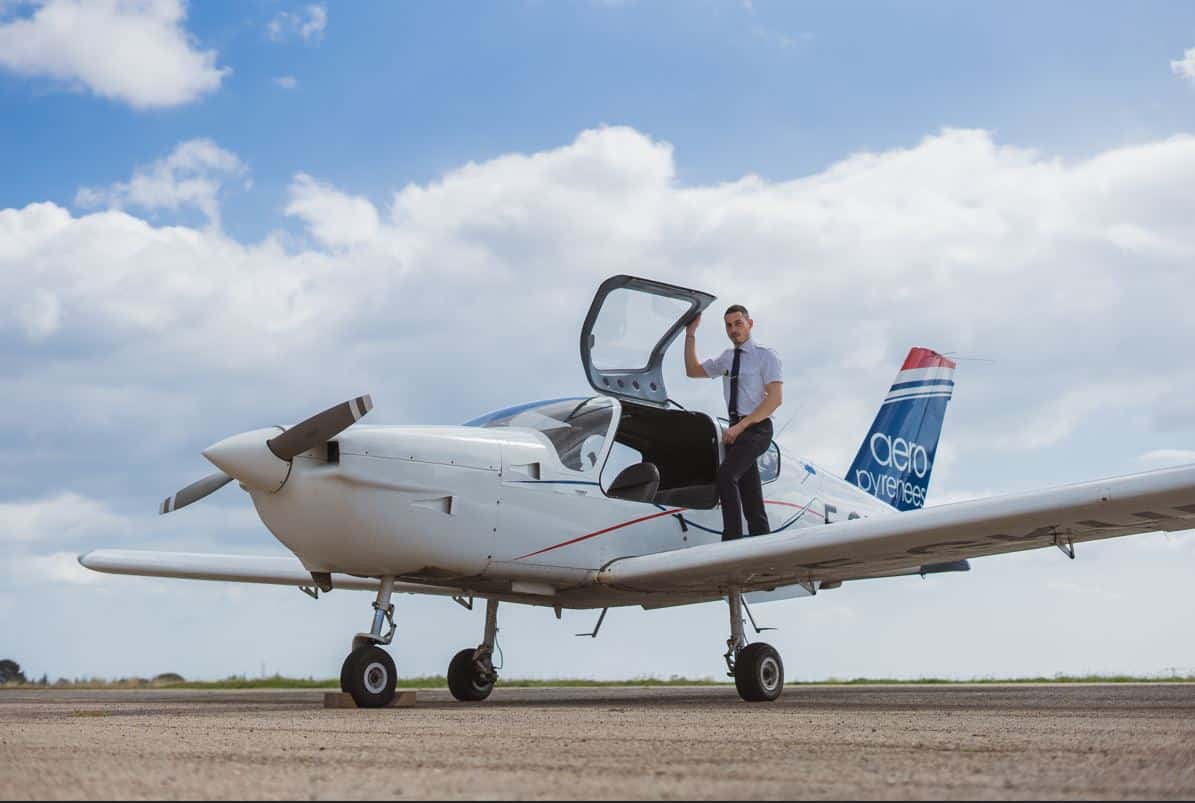
Integrated ATPL training for engineers from ESTACA, EPF & IPSA

As part of your Aeronautical Engineering studies at ESTACA, EPF, or IPSA, Aéropyrénées offers you the opportunity to follow the professional pilot training program alongside your curriculum.

This allows you to complete the theoretical part of pilot training, enhancing your application with major aerospace companies. Frequently required in specific recruitment processes, obtaining the ATPL in addition to your engineering degree is a valuable asset. You will gain expertise in all aspects related to the profession of professional piloting.

The full ATPL program will also enable you to combine engineering skills with piloting expertise, allowing you to shape your career according to your aspirations.

The Integrated ATPL allows you to enter the profession of a professional pilot. All learning phases (theoretical and practical) are included in the training.

Prerequisites

  • Minimum age 18 years

  • Class 1 Medical Examination

  • 3rd year validated from the Aeronautical Engineering course at IPSA, ESTACA or EPF

Educational Outings

  • Control Towers & Operations Center

  • ATPL Training Provided by Experienced Instructors

Training Content

The theoretical part of the ATPL consists of 14 certificates:

  • 010 Air Law and Air Traffic Control Procedures
  • 021 Airframes and Systems, Electricity, Engines
  • 022 Instrumentation
  • 031 Weight and Balance
  • 032 Performance
  • 033 Flight Planning and Monitoring
  • 040 Human Factors & Aeronautical Medicine
  • 050 Meteorology
  • 061 Navigation
  • 062 Radio Navigation
  • 070 Operational Procedures
  • 081 Flight Mechanics
  • 091 VFR Communication
  • 092 IFR Communication

The exam is conducted in the form of multiple-choice questions (MCQs).

Aviation English:

  • 7 hours of classes per day for 5 days
  • Travel training
  • Traffic listening exercises
  • Crew communication training
  • Real traffic listening and comprehension tests

The CPL, or Commercial Pilot License, will allow you to be compensated for your duties as a captain or co-pilot within flying clubs, airline companies, or aerial work organizations.

The MEP training is the qualifying program for flying multi-engine piston aircraft. You will learn to handle asymmetries and engine failure in various scenarios. Highly anticipated by students in training, flying a twin-engine aircraft will allow you to apply all the knowledge gained in real situations.

The objective of the IR training is to enable pilots to fly both day and night under IFR (Instrument Flight Rules) and IMC (Instrument Meteorological Conditions). This qualification is essential for employment with an air transport company, as flights are conducted under IFR conditions. Few jobs will allow you to be compensated as a pilot for VFR (Visual Flight Rules) flights.

The MCC, or Multi-Crew Coordination, consists of a theoretical part (20 hours of classes) and a practical part of 20 hours on an FNPT, with 10 hours as PF (Pilot Flying) and 10 hours as PM (Pilot Monitoring). You will learn to distribute tasks on board and delegate certain responsibilities during all phases of a flight, whether in normal, emergency, or distress conditions.

Outline of Your Training – ATP Engineering

The entire preparation for the theoretical ATPL stage takes place alongside your Engineering studies.

Concepts not covered at ESTACA, EPF, or IPSA will be taught with Aéropyrénées, spread over 25 days of classes.

Following this, there will be a practical component over 9 months to obtain the Commercial Pilot License (CPL), the Instrument Rating for multi-engine aircraft (IR-ME), and the Multi-Crew Coordination (MCC) training.

Registration can take place at the end of the 3rd year. The theoretical classes are conducted during the 4th year of your Engineering program.

NEXT INTAKES ENGINEER – ATPI

Upcoming Intake Schedule

For going further  Engineer Cycle – ATPI

Documentation, training program and pricing